
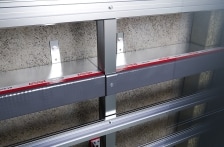
Considering the overall carbon impact on a building through the use of ventilated façade.
Introduction
Whether you are a specifier, contractor, or supplier to the building sector; sustainability is a topic that is increasingly top of mind, especially considering that the build environment contributes to around 40% of global CO2 emissions.[1] At Hilti, we share global climate ambitions to limit global warming to 1,5°C and have committed to the Science Based Targets Initiative working towards net zero emissions by 2050. Our aim is to become our customers’ best partner for sustainability.
To reach global climate goals in the construction industry, it is important to understand the difference between embodied and operational carbon and its contribution to total emissions. Operational carbon is the result of maintaining and using a building (e.g. heating, cooling, ventilation, lighting) during its lifetime. Embodied carbon is the “upfront carbon” emitted during the extraction, production, and transport of materials. Around 13% of the built environment emissions come from embodied carbon.
Until recently, the focus within the construction industry was on the operational performance of a building – how much and what type of insulation and energy is needed for heating and/or cooling (operational carbon). As buildings are becoming more energy efficient, there has been increasing attention on the embodied carbon of materials in recent years.
Façade, as the interface between the inside and outside of the building is impacting both parts of total emissions. Ventilated façade systems with different thermal performances impact the operational emissions of a building, while the material selection of the substructure impacts the embodied carbon footprint. Their selection determines the contribution to building total carbon emissions and the ratio between embodied and operational emissions during the building’s lifespan. As improving thermal efficiency often comes with adding material for insulation, resulting in increased embodied carbon, it is crucial to understand how embodied and operational carbon interact.
Embodied carbon and Environmental Product Declarations (EPDs)
Embodied carbon is the CO2 embedded into the building once established – also sometimes referred to as “upfront carbon”. Façade accounts for 10-20% of a building’s embodied carbon footprint of a building[2]. Aluminum is a significant source of CO2 with a footprint of around 8 kg CO2e per kg material. To be able to transparently declare the carbon emissions and enable product comparison, the EPDs are developed. At Hilti, we are intensively creating the EPDs for our portfolio.
An EPD is a standardised and verified document reporting a product's environmental impacts. The environmental data is created using a holistic life-cycle assessment based on EN15804+A2 standard and is verified by a third-party expert. An essential information in an EPD is the product’s carbon footprint – called the Global Warming Potential (GWP). 
Often one would search for carbon emissions information in an EPD to assess the impact of using a product in a construction project. As indicated in the figure above, A1 to A3 stages play a crucial role in assessing product embodied carbon since it takes up a significant majority of the total CO2 emissions. A1 to A3 stages encompass the utilisation of all materials, products, and energy, as well as waste processing up to the end-of-waste state or disposal of final residues during the product stage. This reflects the CO2 emissions until the product is out of the factory gate, therefore is referred to as “cradle-to-gate” assessment. The lower the CO2 value (GWP) in the A1-A3 stage, the better for the climate.
Here you can find Hilti’s EPDs
The EPDs are valid for 5 years and can be used immediately for your design work and project submittals as needed. You can access our technical documents library to find the EPDs of Hilti products. The EPD files are also available on each product page of your local Hilti website product pages. Additionally, they can also be found in the respective libraries of the verification institute IBU.
How to lower the embodied carbon with Hilti products?
On special request, we offer ventilated façade substructure in low-carbon aluminum and enable you to reduce the embodied carbon footprint of the aluminum substructure by up to 50%. This is achieved by using renewable energy in production processes and recycled content.
Additionally, we provide a CO2 footprint calculation to demonstrate the carbon emission savings achieved by using low-carbon aluminium. Choosing low-carbon materials allows you to reduce the emissions during your project compared to traditional aluminium, differentiate yourself from competitors and collect points for Green Building Schemes (such as BREEAM and LEAD).
Improving the building’s thermal performance and significantly reducing carbon footprint throughout its lifespan
Façade is the building component with the biggest surface area and as an interface between the outside and inside area, it is a relevant contributor to the building’s energy efficiency.
Ventilated façade is a multi-layer system consisting of substructure, insulation, and cladding. The substructure is penetrating insulation and causing a thermal bridge, therefore negatively influencing the overall thermal resistance of the wall.

*U-value differentiates based on the used substructure system; standard aluminium or system with thermal-bridge free/reduced bracket.
Considering the influence of the substructure in the early design phase can significantly contribute to improving the thermal performance and operational carbon footprint of the building. Only by switching from aluminium to an aluminium-polyamide bracket with a minimised thermal bridge, the thermal performance of the wall improves by 34% and with the same insulation thickness the U-value is reduced on 0,12 W/m2K instead of 0,18 W/m2K. Stainless steel brackets can also bring significant improvements in U-value reduction but none as significantly as that of a aluminium-polyamide bracket.

Figure 1: System optimisation through U-value reduction.
It is important to acknowledge the impact of the substructure on carbon footprint not only in the short term, where the embodied carbon plays a major role but also in the long term. Our case study of a ten-story office building showed that already after the second year the operation carbon is the main contributor to the total carbon emissions.
Building assumptions used in the case study:
- Location: London (UK)
- Base material: Concrete
- Cladding: Fiber cement
- Insulation: Mineral wool
- Building width and length: 20x30 m
- Number of floors: 10

Figure 2: Operational carbon plays a significant role in total carbon emissions over the building's lifespan. Therefore, it must be considered when striving to achieve sustainability goals.
Hilti offers a range of ventilated façade substructure systems to meet specific needs for building thermal and static performance. 
Hilti can assist you in achieving your sustainability goals
Decisions to reduce carbon emissions must consider the embodied as well as operational carbon impact on a façade.
- Embodied emissions become negligible from a long-term perspective, accounting for 20% for standard aluminium systems and 31% for thermal bridge-free systems of total emissions after 25 years. The primary contributor to overall carbon emissions is the operational emissions resulting from cooling and/or heating the building.
- Due to stricter requirements, the energy efficiency of buildings is continuously improving, and the embodied carbon of the material is receiving more attention. As energy sources become cleaner and buildings become more energy efficient, the proportion of embodied carbon in the total carbon footprint increases.
Hilti optimises building performance through value engineering and design optimisation. Our approach involves offering different substructure design options and conducting U-value and carbon emissions calculations. This comprehensive offering equips our customers with the necessary data to make the right decision.
We want to foster transparency and collaboration within the value chain to achieve sustainable construction.
Collaboration in design and sharing case studies is the key to inspire and raise awareness of existing solutions for a more sustainable future. We welcome your thoughts on this topic and invite you to post any questions regarding the article or Hilti's sustainability offerings on Engineering Centre.
