
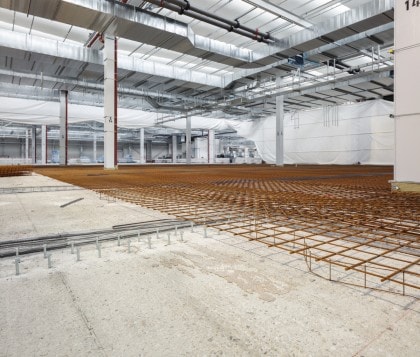
What is concrete overlay?
Introduction
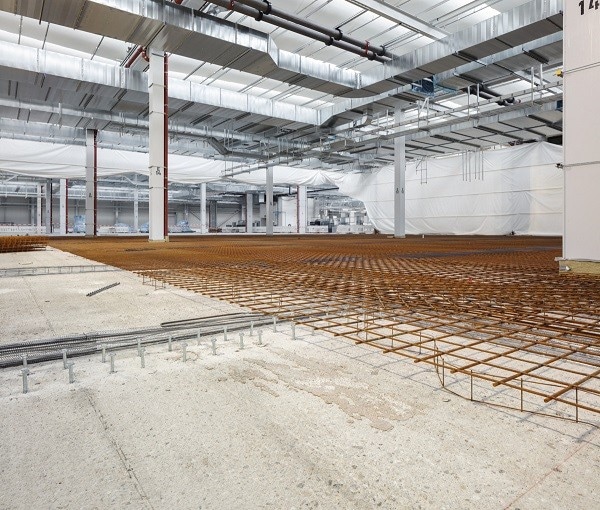
The installation of new, retrofitted concrete layers (concrete overlay) is becoming increasingly important due to the growing need for repair and reinforcement of existing structures.
Bridge cross sections reinforced by a new concrete layer as well as the repair and reinforcement of existing concrete components by a new concrete layer are typical examples of the use of overlay, see Figure 2. If the shear stresses in the bonded joint between the concrete layers that were poured at different times are not sufficiently transferred, the structural safety is at risk.
Typical examples are shown schematically in figure 1 & 2
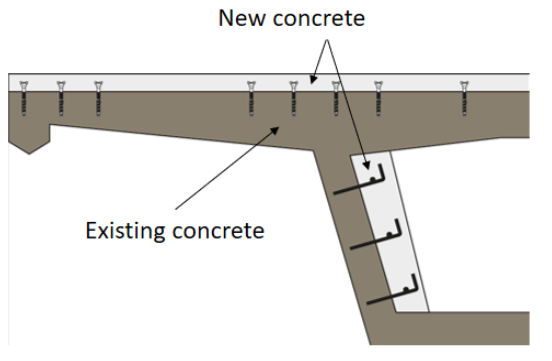
Fig 1. Example of strengthening of bridges by means of concrete overlays
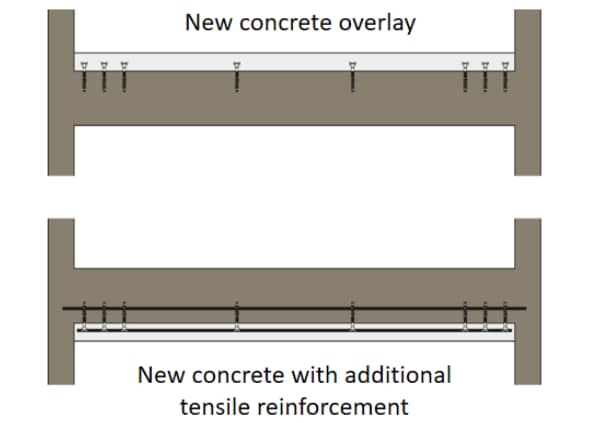
Fig 2. Example of Strengthening of buildings, decks and slabs
Figure 3 a shows the stress state of a beam without the activation of shear stresses between the concrete layers (unreinforced interface) In this case, the concrete layers behave independently of each other.
This is a simplification, because even in the case of an unreinforced interface, an adhesive bond acts between the concrete layers.
However, the adhesive bond is already impaired at relative deformations of 0.03mm to 0.05mm due to cracking between the interfaces.
To achieve a monolithic connection, post installed shear connectors are usually placed in the structure. This allows, for example, bending compression and/or bending tension zones to be enlarged (structural reinforcement) or the original zone heights to be restored (refurbishment), see Figure 3b.
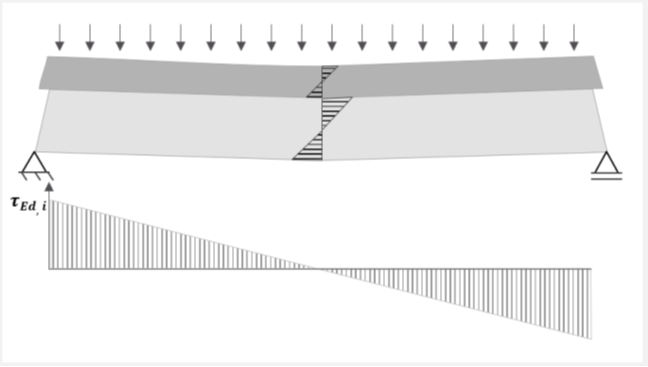
Figure 3a) Beam without the activation of shear stress in the interface
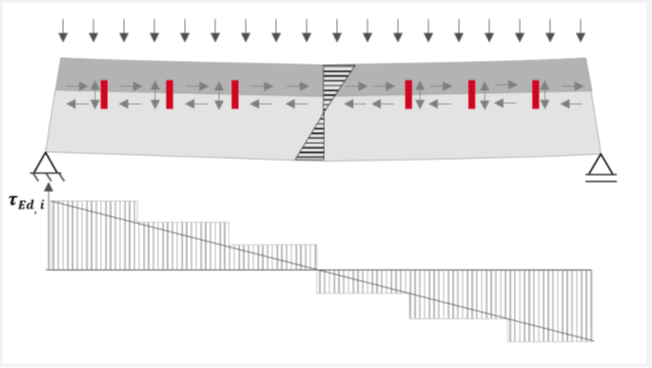
Fig 3b) Beam with the activation of shear stress in the interface
Advantages of strengthening with concrete overlay
1. Simple and reliable application to a variety of cases
2. Monolithic structural component behaviour assured
3. Shear forces are reliably transferred even if the interface is cracked
4. Suitable for use with the more common methods of surface roughening
5. Reduced requirements for anchor embedment
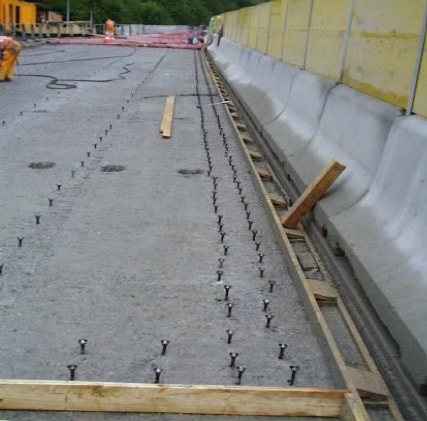
Example of rehabilitation of a bridge deck
You are also welcome to ask us for support: simply leave a comment or post your question in the community, or improve your knowledge and skills via our Webinars or training sessions.
For the latest news in engineering solutions and innovations follow us on: LinkedIn, Instagram and Twitter
This article is part of an ongoing series dedicated to Rebar topics. Find more here
