
The application – Fastening on Steel
The application – Fastening on Steel
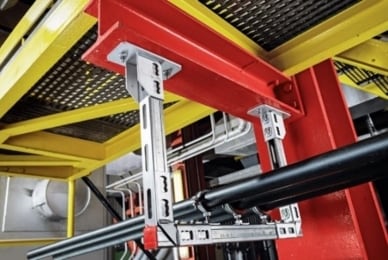
If you have ever been involved in the design or management of an Energy and Industry (E&I) project, you have likely faced the challenge of fixing elements to coated steel. Some of the most common elements are (see Figure 1):
- Equipment
- Platforms
- Cable trays for services, namely electrical and telecommunication
- Piping supports
- Multi-disciplinary supports, including mechanical, electrical and HVAC trades.


Figure 1 - Fixing of cable trays (left) and piping (right) supports to steel.
Traditionally, there are two ways of fixing the above-mentioned elements to the steel structure, which are (i) welding and (ii) bolting (see Figure 2).


Figure 2 - Traditional ways of fixing elements to steel: welding (left) and bolting (right).
Traditional methods for Fastening on Steel
Welding is a method that is very reliable and robust, which is why it has been used for decades. However, when it comes to traditional welding, there are some challenges, namely:
- A nearby power plug is required, which can be hard to find on a construction site;
- Flying sparks, being a potential risk in terms of Health, Safety and Environment (HSE);
- It’s a time consuming task;
- It requires a qualified welding operator;
- In coated steel, some rework will be needed after the welding takes place.
One alternative, Bolting, consists of driving holes on the steel structure to pass bolts that should be accessible from both sides to help ensure a proper fixing. From a tool perspective it represents a low investment, however there are some challenges associated with this method, especially:
- Slow and exhausting process for the operator;
- Not ergonomic, since it can be difficult to execute in some locations/directions;
- It requires corrosion protection before bolting;
- If it needs a magnetic drill to support, there can be issues with disposal.
Hilti’s Solutions for Fastening on Steel
To give an answer to the challenges mentioned above in the traditional methods of fastening on steel, Hilti has been working on the development of new stud solutions, having a long history and broad experience in this area. Here, we can highlight four different Hilti product solutions: (i) X-ST GR, (ii) X-BT, (iii) S-BT HL and (iv) F-BT. A schematic representation of the 4 solutions can be found in Figure 3.
The first solution launched by Hilti, in 1994, was X-ST GR. It is a stainless steel threaded stud directly fixed to steel through a powder actuated tool, making it a very fast solution.
The X-BT is a stainless-steel threaded stud and works with a blunt tip weld technology. The first generation of the X-BT was launched in 2003, more than 20 years ago. Part of the steel is punched down into a pre-drilled hole during the fastener setting, generating high temperature and causing friction welding. There is a fusion along the entire perimeter, meaning that no humidity can then penetrate the pilot hole, ensuring protection against corrosion.
The S-BT HL fasteners, launched in 2023, are the second generation of S-BT, originally launched in 2016. The fasteners are threaded studs manufactured from hardened carbon steel 1038 and austenitic-ferritic (Duplex) stainless steel. The fixing technology is called blunt tip self-welding, where a pilot hole is done and then a threaded stud is screwed into the hole. The threaded stud has a diameter slightly higher than the diameter of the hole, so high torques are needed for the application. The first thread of the screw is the cutting thread this will form the inner thread in the base material where the S-BT HL is screwed. This lower thread does not have loading capacity. Afterwards, the intersection of the other threads of the screw and the threads of the base material will ensure load capacity and robust fastening.
The F-BT fasteners are part of a system called Cordless Stud Fusion, which is a welding process. It is classified as a drawn arc stud welding with shielding gas. The drawn arc stud weld process utilises a welding power supply to create an electric arc along a circuit created between the stud and parent material. The electric arc travels between the two materials via an air gap, generating an intense, concentrated heat used to melt the stud’s base and a small area of the parent material. Once the materials are melted appropriately, the stud is plunged into the molten area and held in place as the metals solidify to form the welded connection. Besides being a welding process, this system has no need for external power source and it’s a consistent and virtually spark-free process.


Figure 3 - schematic representation of Hilti's solutions for fastening on steel: X-ST GR (top left), X-BT (top right), S-BT HL (bottom left) and F-BT (bottom right).
Regarding load values and which solution to apply,
- X-ST GR is optimised for light duty applications (recommended tension load value of 1,8 KN)
- X-BT and S-BT are optimised for medium duty applications (recommended tension load value of 3,6 KN per stud),
- F-BT can be used for heavy duty applications (recommended tension load of 8 KN).
There are differences also based on the minimum base material thickness, since F-BT can be applied from 4 mm, S-BT HL and X-ST GR from 6 mm and X-BT from 8 mm.
Please note that, in those cases, were the studs are applied to lower base material thicknesses, we should a consider a load reduction according to the technical manuals as well as the possibility of backside damage of the base material.
If you want to find out more about the static design of Hilti’s Fastening on Steel solutions, check the following article.
You are welcome to ask us for support: simply leave a comment or post your question in the community, or improve your knowledge and skills via our Webinars or training sessions.
For the latest news in engineering solutions and innovations follow us on: LinkedIn, Instagram and Twitter
