
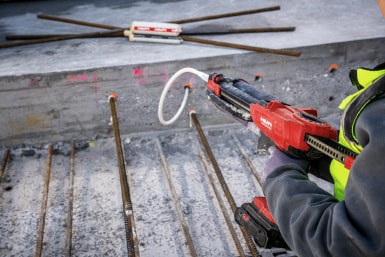
Building codes aim to prevent unnecessary loss of life and assets.
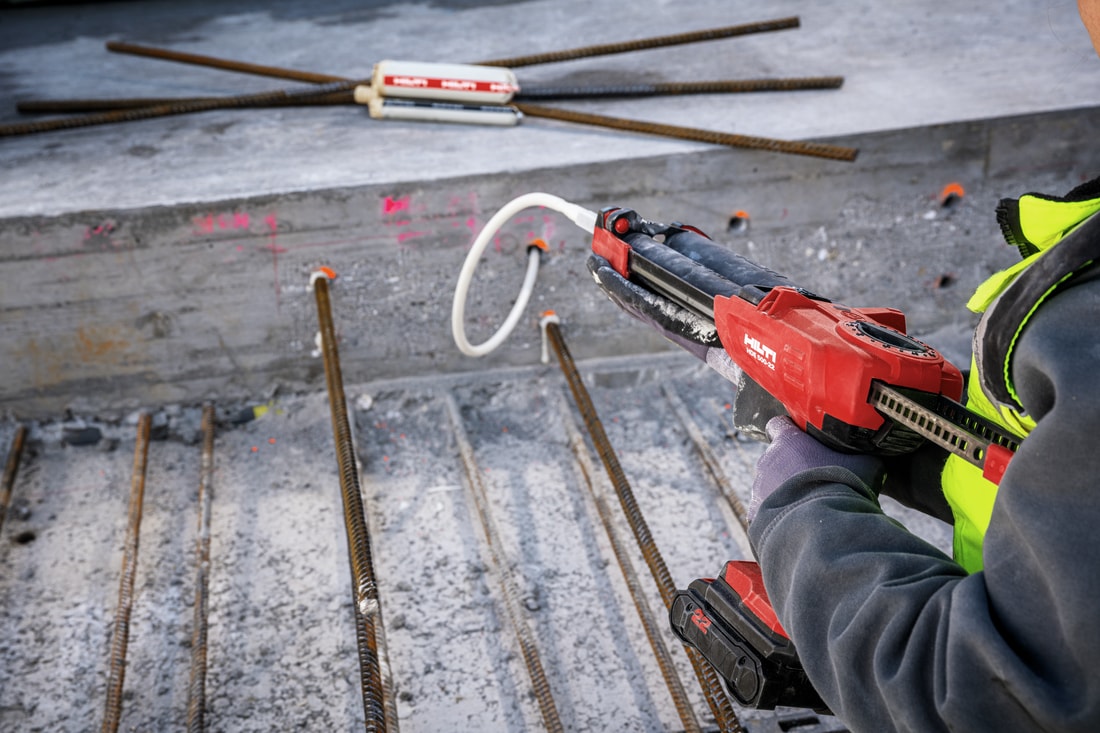
Every 2 seconds, a fire department responds to a fire somewhere in the world. Fire impacts the stability of concrete structures, which can lead to complete or partial collapse and risk occupants lives.
On that note, clients, designers and contractors are mandated by Eurocode 2 to ensure building safety in the event of fire. Safety in the case of fire is one of two essential requirements for buildings and civil engineering works. Compliance is proven through the application of Eurocodes. Eurocodes provide design rules for structures constructed using traditional methods and expert consideration is prescribed for “unusual forms of construction” that are not explicitly covered in the code.
The objective is to ensure:
- The load bearing resistance of the construction can be assumed for a specific period of time.
- Occupants can leave the works or can be rescued by other means.
- The safety of rescue teams is taken into consideration.
Linking the Eurocode rules with the Building Safety Act regulations we see that:
- Gate 1 – Planning Stage: Applicants will need to demonstrate that fire safety matters have been considered. Structural engineers must design load-bearing elements to the structural fire resistance determined by the fire consultant.
- Gate 2- Stop/Go point: must demonstrate that what was specified will be properly installed in a professional and compliant way. Training on site is really relevant for this matter.
- Gate 3 – Completion/Final Stage: Demonstrate that what was specified was properly installed in a professional and compliant way.
1 Post installed rebar application according to EAD 330087
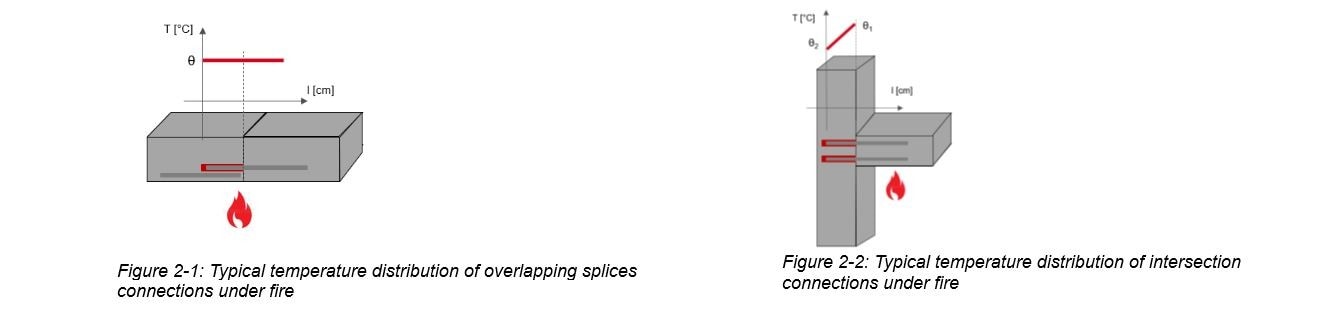
The current article specifically examines post-installed rebar connections according to EN 1992-1-1, where the system holds an ETA according to EAD 330087-02, with a main focus on the fire design. Some application examples are lap splices with existing reinforcement or anchorage of a reinforcement in a slab or foundation with existing cast-in bars (see Figure 2-1 to Figure 2-2).
1.2 Why is fire design so important?
Fire is certainly a clear danger to any construction and needs to be prevented as a fire may occur anywhere and at any phase over the lifetime of a building, whether during construction or during service.
When post-installed reinforcing bar connections are part of a fire-rated assembly (floor, roof, etc.), it is important that the fire resistance of the connection is evaluated using test data for the time-dependent reduction in bond strength associated with typical geometries and time-temperature loading protocols.
In general, these elements are designed and constructed to provide a specific period of fire load-bearing capacity resistance (R), typically rated for 30, 60, 90, 120, 180 or 240 minutes. To maintain this fire protection against spreading, architects divide the building into “small boxes” in an act called compartmentation (Figure 1).


Figure 1: example of fire compartmentation
The post-installed connections involved in fire can be divided into two types:
- Overlapping splices, such as slab-to-slab connections, where the surface is exposed to fire with the temperature along the anchorage length being constant and a function of the concrete cover during the duration of fire (Figure 2-1).
- Intersections, such as simply supported slab-to-wall connections, where the surface of the existing element and that of the new element are exposed and the temperature along the anchorage length is not constant (Figure 2-2).
2 Fire performance
The bond strength of all post installed rebar systems decreases with increasing concrete temperature. The relationship between concrete temperature and residual bond strength is highly mortar dependent (see figure 3). To count on a safe connection the mortar will need to remain with a sufficient bond strength after the concrete temperature increases.

Figure 3 - material performance under high temperatures
Yellow line - FP700 Blue line - Concrete Green line - Steel
HIT-FP 700 R is not simply an additional injectable system: it is a new technology. HIT-FP 700 R is the only injectable cement-based mortar which can be stored for 12 months as paste yet and it is also the only chemical mortar with high performance under fire and no creep behaviour at high temperatures.
The HIT-FP 700 R technology enables a new chapter in the qualification of injectable chemical mortars for which an update of the previous EAD 330087-01 was needed.
3 Differences and similarities between HIT-FP 700R, grouts and resin based mortar
HIT-FP 700 R as an inorganic cement-based mortar (see figure 4) provides unique fire resistance properties which are superior to those of resin-based mortars. Due to its inorganic characteristics, HIT-FP 700 R has a more stable displacement and performance at high temperatures. However, unlike inorganic grouts, it is characterised by its safer, more flexible and increased user-friendly application properties, which resemble the application of resin-based mortars. HIT-FP 700 R is applied by using our standard two-component injection system.
This technology tackles limitations for the installation direction, which is typical of grouts (i.e., only downwards or inclined). The automatic use of predefined mixing proportions during injection clearly reduces the risk of erroneous or inconsistent mixing proportions, which is vital for the performance and durability of the mortar and may occur when handling commercially available grouts on the job site. A tailored smooth consistency helps to avoid the need for large drilling diameters when compared to the rebar size, minimising the amount of HIT-FP 700 R mortar needed.
The qualified anchoring mortar for post-installed rebars typically follow these guidelines:
- Declaration of performance based on EN 1504-6
- ETA (European Technical Assessment) based on EAD 330087-02
- ESR (Evaluation Service Report) based on ICC-ES AC308
Furthermore, as with other mortars in Hilti's injectable mortar portfolio, HIT-FP 700 R is offered with Hilti SafeSet technology, in which dust is automatically extracted during the drilling process and the drill hole is additionally cleaned in compliance with the ETA. The mortar is injected into the borehole with an automatic dispenser before the element is inserted. Hilti SafeSet system is a combination of anchor system components that significantly increase the rebar's robustness and help to significantly reduce potential user errors during the installation process.
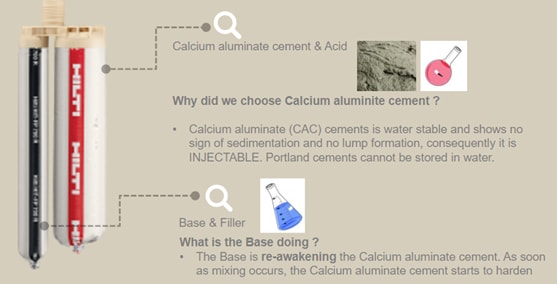
Figure 4 - FP700 composition
4 Hilti support for concrete to concrete connections and fire design
Try out our engineering design software today for your post installed rebar connection in fire design calculations https://profisengineering.hilti.com/ with dedicated training modules available in the Hilti academy
You are also welcome to ask us for support: simply leave a comment or post your question in the community, or improve your knowledge and skills via our Webinars or training sessions.
For the latest news in engineering solutions and innovations follow us on: LinkedIn, Instagram and Twitter
This article is part of an ongoing series dedicated to Rebar topics. Find more here
