

Questions on using supplementary reinforcement in PROFIS Engineering
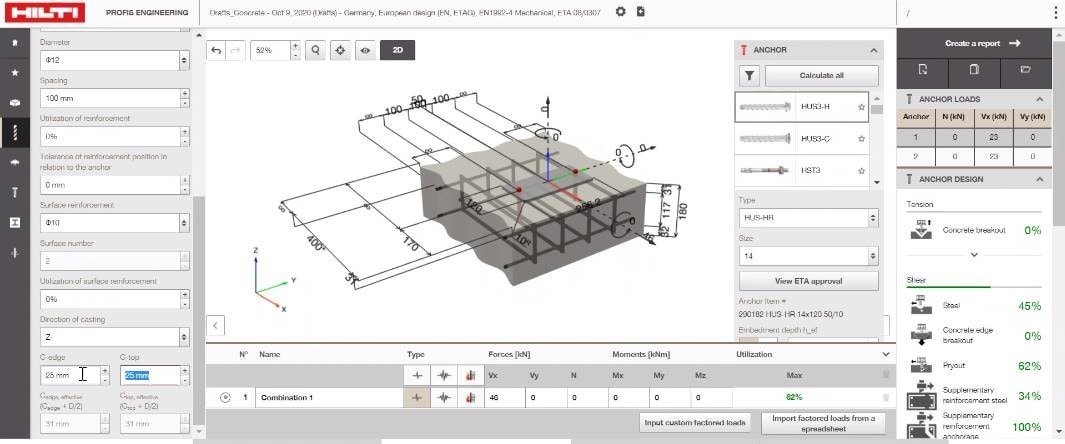
Q1.- What happens if fixing into a slab with mesh reinforcement? Do you have to do two separate checks to consider the supplementary reinforcement in both directions?
The verification of concrete edge breakout should be done in each edge. This means, that, supplementary reinforcement is only effective in the direction perpendicular to that edge. If the reinforcement is straight, then it requires an anchorage length inside the breakout body of 10*diameter, at least.
Q2.- When calculating additional force due to eccentricity of shear load, it appeared to be overall depth of the concrete section that influenced this. Why is this the case and is embedment depth of the anchor not relevant to calculation of this force?
The additional shear force due to eccentricity has into account the overall depth of the concrete section. That's because the shear load in the reinforcement, must be in equilibrium with the compression forces in concrete. The anchor h_ef is relevant mainly to determine the lever arm "z". Per Eurocode 2-4 section 6.4.3 (1), the lever arm can be assumed approx. 0.85*d, where d is limited to 2*hef, 2*c1.
Q3.- Where can I find the factor k8 listed in the formula?
in the corresponding ETA (k8=2 as default for hef>60mm) and 1 for hef<60mm)
Q4.- Is the interaction resistance reduced by 1/3 with supplementary reinforcement?
The interaction exponent is 2/3, so the interaction is significantly reduced if there is supplementary reinforcement for SHEAR only. If there is supplementary reinforcement for TENSION only, the interaction is also reduced. The only case where the interaction is not reduced, is if the supplementary reinforcement exists both for TENSION and SHEAR loads.
Q5.- Why the anchorage length l1 doesn't take into account vertical part of the hooked rebar? It seems to take only the length on the surface of the concrete
The shape of the rebar is considered. If there is for example a hook the length can be reduced
Q6.- Can you put reinforcement in two directions in a corner?
Right now, this is not possible. This is something which we may develop in the near future.
Q7.- If you set load parallel to edge in PE (say 10kN for example) why does the software do a check with approx. half the load for supplementary reinforcement at edge break out?
Based on EN 1992-4 an increase factor of 2,0 is given in case of parallel shear force. On the acting side this would to half of the load which is applied towards the edge in the direction of suppl. Reinforcement
Q8.- In a case when an anchor is not placed exactly in the middle between two rebars, would l1 dimension be checked for each rebar separately?
Yes. Every rebar is checked, and the report shows the highest utilisation
Q9.- Is there a way to know of typical residual capacity of reinforcement designed in already e.g. by the concrete designer, that I might be able to use as 'supplementary reinforcement’?
No. We need to contact the responsible designer at each opportunity to determine if there is spare capacity
Q10.- Can this supplementary rebar be installed as post installation. i.e. using the principles of rebar with RE 500 in holes drilled around the anchorage? The question is about supplementary reinforcement for tension and that we have still not released – It is work in progress and we will be able to address cases like this shortly. However, the issue with this procedure is that in this case one probably lacks the surface reinforcement which according to the model is required for equilibrium.
Q11.- If the concrete pour direction is not known, is there a standard direction that we should use / should we use the direction that provides the most conservative result? Why does the direction of pouring play such a critical role?
The adhesion ratio is regulated in EN1992-1; 8.4.2. The position and direction of the reinforcing bars in relation to the height of the concrete structure and the casting direction play a role. With horizontal rebar and a thin concrete construction (for example a slab of <250 mm), all positions are assumed to provide good adhesion. With a high concrete construction such as a pillar (> 600 mm), poor adhesion for the top 300 mm and good adhesion for the rest are assumed. For concrete structures with a height of 250-600 mm, the bottom 250 mm is assumed to have good adhesion. The standard is based on experience of how well / badly the concrete can be assumed to vibrate in connection with the casting.
Q12.- Can PROFIS Eng. illustrate the effect of supplementary reinforcement on the flexible baseplate solution?
Yes. And the report is quite comprehensive! However, it is easier to modulate the reinforcement in the rigid mode first before switching to CBFEM (Finite Element Model)
Q13.- In which version of PROFIS Engineering is supplementary reinforcement available?
Supplementary reinforcement is available in both version of PROFIS Engineering – PREMIUM (Charged) and STANDARD (Free).
You can start your free trial here
or visit our website for more information here
You are also welcome to ask us for support: simply leave a comment or post your question in the community, or improve your knowledge and skills via our Webinars or training sessions.
For the latest news in engineering solutions and innovations follow us on: LinkedIn, Instagram and Twitter
To view further articles on PROFIS Engineering please click here
